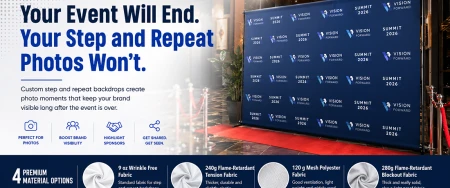
Why step and repeat backdrops have become one of the most effective ways to turn event photography into lasting brand exposure.
The event might last four hours.
The photos can last for years.
Long after the lights go down, the guests leave, and the venue is cleaned up, those event photos can keep circulating. On social media. In press coverage. On company pages. In sponsor posts. In memories shared by attendees.
And if your brand is sitting behind those photos, your event isn't really finished.
That's the power of a great step and repeat backdrop.
What started as a familiar fixture at red carpet events has become a versatile branding tool for corporate events, trade shows, conferences, fundraisers, product launches, sporting events, school events, and brand activations.
But there's a difference between simply putting logos on a backdrop and creating a photo moment people actually want to stand in front of.
That's what we're getting into.
What Is a Step and Repeat Backdrop?
A step and repeat backdrop is a custom event backdrop featuring a repeating pattern of logos, brand names, graphics, or sponsor identities.
The idea is simple: people stand in front of the backdrop for photos while the branding remains visible behind them.
You've probably seen them at:
- Red carpet events
- Corporate conferences
- Award ceremonies
- Trade shows
- Fundraisers and galas
- Product launches
- Grand openings
- Sports events
- School and university events
- Media events
- Brand activations
The format works because it combines several things an event needs anyway:
Brand visibility + photography + sponsor recognition + a polished event presentation.
That's a pretty efficient piece of event marketing.
Why Step and Repeat Backdrops Still Matter in 2026
Here's what has changed.
People don't just attend events anymore. They document them.
- A guest takes a photo.
- A speaker posts a recap on LinkedIn.
- A sponsor shares pictures from the event.
- The event organizer uploads a gallery.
- Someone creates a Reel.
- Someone else reposts it.
The physical event may be over, but the visual footprint of that event continues online.
That's part of the larger shift toward more experiential and visually engaging events. Modern event marketing increasingly focuses on creating moments people participate in, photograph, and share rather than simply surrounding attendees with traditional signage.
And that's exactly where a custom step and repeat backdrop earns its place.
You're not just branding a wall.
You're branding the background of the photograph.
A Step and Repeat Isn't Just a Logo Wall Anymore
This is probably the biggest change in how we should think about them.
Traditionally, the formula was:
Logo + logo + logo + logo.
Today, the better question is:
What should this event look like when someone sees the photos afterward?
A step and repeat can become a dedicated branded photo area.
It can reinforce sponsors.
It can establish the visual identity of a conference.
It can give a product launch a recognizable background.
It can create a consistent look across an entire event.
It can even become the unofficial "photo spot" that attendees naturally gravitate toward.
The best backdrops don't scream:
"LOOK AT OUR LOGO!"
They create an environment where the logo naturally ends up in the picture.
That's a much smarter form of branding.
What Makes a Great Step and Repeat Backdrop?
A good backdrop isn't just about printing quality.
The design matters just as much.
1. Make the Logos Visible
This sounds obvious, but it's one of the easiest mistakes to make.
If you have ten sponsors, the temptation is to make every logo smaller so everything fits.
Don't.
A logo that technically exists on the backdrop but disappears in the photograph isn't doing much work.
Give the branding enough space to remain recognizable.
2. Think About Where People Will Stand
Your backdrop is going to have people in front of it.
That's the entire point.
So design around that reality.
Consider where heads, shoulders, and bodies will cover the artwork.
Important branding shouldn't be concentrated only in the areas most likely to be blocked.
3. Pay Attention to Spacing
The repeated pattern should feel balanced.
Too much space can make the backdrop look unfinished.
Too little space can make it feel chaotic.
A strong step and repeat design should look intentional from across the room and still photograph well up close.
4. Don't Let the Branding Fight the Photograph
This is where restraint matters.
Your backdrop should support the people standing in front of it, not compete with them.
Strong contrast, clean spacing, and a controlled color palette usually work better than throwing every brand element onto one piece of fabric.
Step and Repeat Backdrop Size: How Big Should It Be?
There isn't one magic size for every event.
The right step and repeat backdrop size depends on how you're going to use it.
Ask yourself:
How many people will be photographed at once?
A backdrop for individual portraits has different requirements than one intended for groups.
Will the photographs be full-body or waist-up?
This changes how much vertical space is actually useful.
How far away will the camera be?
The photographer's position affects how much of the backdrop appears in the final image.
How much space does the venue have?
A huge backdrop squeezed into a small room can create more problems than it solves.
The goal isn't:
"What's the biggest backdrop we can buy?"
The goal is:
"What's the right backdrop for the way people will photograph in front of it?"
That's a much better way to choose.
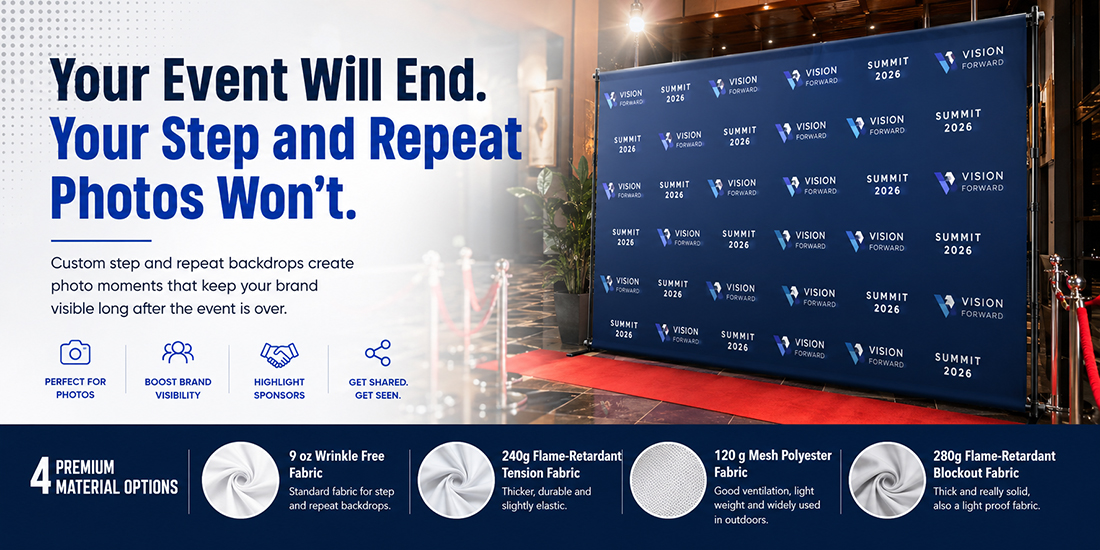
One Backdrop. Four Materials.
Not every event calls for the same backdrop material.
An indoor corporate conference, outdoor sporting event, and premium gala can have completely different requirements.
That's why we offer our step and repeat backdrops in four different materials, giving you the flexibility to choose based on your event, environment, and desired finish.
The standard fabric for step and repeat backdrops.
Lightweight, versatile, and well suited for everyday event and photo backdrop applications.
Great for: Indoor events, conferences, parties, photo walls, and general step and repeat use.
240g Flame-Retardant Tension Fabric
Thicker, durable, and slightly elastic.
The added weight and slight elasticity help create a more substantial and taut appearance.
Great for: Premium event environments, corporate events, trade shows, and applications where a thicker fabric is preferred.
Lightweight, breathable, and built for airflow.
The mesh construction allows air to pass through the material, making it particularly useful for outdoor applications.
Great for: Outdoor events and applications where ventilation and reduced wind resistance matter.
280g Flame-Retardant Blockout Fabric
Thick, solid, and light-blocking.
This heavier material is designed to provide a more substantial appearance while blocking light from passing through.
Great for: Applications where minimal show-through and a solid backdrop appearance are important.
Which material should you choose?
Think about the environment first.
Want a versatile standard option?
Choose the 9 oz Wrinkle-Free Fabric.
Looking for something thicker and more premium?
Consider the 240g Flame-Retardant Tension Fabric.
Taking your backdrop outdoors?
The 120g Mesh Polyester Fabric provides useful airflow.
Need something thick and light-blocking?
The 280g Flame-Retardant Blockout Fabric is the natural choice.
There isn't one "best" material.
There's the best material for your event.
How to Design a Step and Repeat Backdrop That Looks Great in Photos
Here's a simple rule:
Design for the camera, not just the wall.
A backdrop can look fantastic in your artwork file and still look underwhelming in the final photograph.
Before approving the design, consider:
Logo Size
Make sure logos remain recognizable from the expected camera distance.
Brand Colors
Your colors need to work under the actual lighting conditions of the event.
Contrast
Important branding should stand out from the background.
Repetition
Create a pattern that feels consistent without becoming visually overwhelming.
Photo Composition
Think about where people will stand and how much of the backdrop will actually appear in the image.
Sponsor Hierarchy
If multiple sponsors are involved, decide which logos deserve prominence before building the pattern.
Try the 3-Second Test
Here's a simple test we like.
Look at a finished event photo for three seconds.
Then ask:
Can you tell whose event it is?
If the answer is yes, the branding is doing its job.
If the answer is no, adding more logos probably isn't the solution.
Better placement might be.
Better contrast might be.
Better spacing might be.
Sometimes less branding actually creates more brand recognition.
Where Can You Use a Step and Repeat Backdrop?
One of the reasons step and repeat backdrops have stuck around is their versatility.
Corporate Events
Use a branded photo backdrop for conferences, networking events, employee celebrations, company milestones, and executive gatherings.
Trade Shows
Create a dedicated photo area within your booth or event space while keeping your brand visible in attendee photos.
Award Ceremonies
Award recipients already want photos.
A branded backdrop gives those photos a consistent event identity while giving sponsors valuable visibility.
Red Carpet Events
This is where the step and repeat became famous.
Entertainment events, media appearances, premieres, and formal occasions all benefit from a recognizable branded photo wall.
Fundraisers and Galas
A sponsor backdrop can give participating organizations recognition while creating an attractive photo area for guests.
Product Launches
A custom backdrop can help establish a consistent visual identity around the launch and create a natural photo opportunity.
Sports Events
Teams, leagues, tournaments, and sponsors can use step and repeat backdrops for player photos, media appearances, sponsor recognition, and event photography.
School Events
Graduations, athletic celebrations, banquets, alumni events, and fundraisers can all benefit from a custom event backdrop.
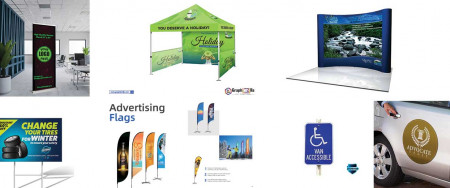
Step and Repeat Backdrop vs. Other Event Backdrops
Not every event needs a step and repeat.
Different displays solve different problems.
Best for repeating logos, sponsor recognition, and branded photography.
Better when you want one large continuous graphic, photograph, scene, or message.
Designed more specifically around booth presentation and communicating your brand or marketing message.
A great option when you need portable messaging in a smaller footprint.
Often used for press events, celebrity arrivals, corporate events, and high-visibility photography.
The right display isn't necessarily the one with the most graphics.
It's the one that matches the job.
How to Make Your Step and Repeat More Shareable
Here's where event branding gets really interesting.
Don't design your backdrop only for the people physically attending the event.
Design it for the people who will see the photos later.
Think about:
- Camera positioning
- Lighting
- Logo visibility
- Brand colors
- Photo composition
- Sponsor placement
- Event hashtags
- QR codes where appropriate
The surrounding environment
But don't turn your backdrop into a giant advertisement.
A good photo moment should feel like a photo moment first and an advertisement second.
Give people a reason to stand there.
Make the setting look good.
Keep the branding visible.
Then let the photograph carry the message.
Common Step and Repeat Backdrop Mistakes
A little planning can prevent a lot of headaches.
Making the Logos Too Small
Trying to fit more logos isn't always better.
If they're impossible to recognize in photographs, you're sacrificing visibility for quantity.
Ignoring Event Lighting
Your backdrop won't be photographed under the same lighting conditions as your computer screen.
Think about the actual venue.
Choosing the Wrong Size
Too small and group photos become difficult.
Too large and you're spending money and space you may not need.
Using the Wrong Material
Indoor and outdoor environments can have very different requirements.
Consider airflow, light, durability, venue conditions, and installation before selecting the material.
Designing Only for the Venue
This is the big one.
A backdrop isn't just something people look at.
It's something they stand in front of.
Design it accordingly.
Are Step and Repeat Backdrops Still Worth It?
For the right event, absolutely.
If your event involves photography, sponsors, branding, media coverage, or social content, a step and repeat backdrop can pull several marketing jobs into one physical display.
It gives people a place to take photos.
It keeps sponsors visible.
It reinforces the event's identity.
It creates consistent imagery.
And it puts your brand directly into the content people create.
That's a pretty good job description for a piece of printed fabric.
The Best Step and Repeat Is the One People Want to Stand In Front Of
A step and repeat backdrop may look simple.
A backdrop.
Some logos.
A few people standing in front of it.
But there's a lot happening behind that simple setup.
It's creating an identifiable visual moment.
It's helping sponsors get seen.
It's giving attendees a reason to take photos.
It's creating content that can live well beyond the event itself.
And it's putting your brand exactly where you want it:
in the picture.
So whether you're planning a corporate conference, trade show, awards ceremony, fundraiser, product launch, sporting event, or brand activation, don't think of your step and repeat as another piece of event signage.
Think about the photograph.
Think about the people standing in front of it.
Think about where that photograph might end up tomorrow.
Because the event will end.
Your step and repeat photos won't.
Frequently Asked Questions
What is a step and repeat backdrop?
A step and repeat backdrop is a custom event backdrop featuring a repeating pattern of logos, branding, or graphics. They're commonly used for event photography, sponsor recognition, trade shows, corporate events, and media appearances.
What size should a step and repeat backdrop be?
The ideal size depends on the number of people being photographed, camera distance, photo framing, available venue space, and how the backdrop will be used.
What material is best for a step and repeat backdrop?
It depends on the application. 9 oz Wrinkle-Free Fabric is a versatile standard option, while 240g Tension Fabricprovides a thicker, more durable choice. 120g Mesh Polyester is well suited for outdoor applications where airflow matters, while 280g Blockout Fabric provides a thick, light-blocking option.
Can a step and repeat backdrop be used outdoors?
Yes. However, outdoor applications require careful consideration of material, airflow, installation, weather, and wind conditions. Mesh polyester can be particularly useful where ventilation is important.
How many logos should be on a step and repeat backdrop?
There is no universal number. Logos should be large enough to remain recognizable while maintaining a balanced repeating pattern.
What is the difference between a step and repeat backdrop and a banner?
A step and repeat backdrop is primarily designed for repeated branding and photography. A banner can serve a wider range of promotional and informational purposes.
Can I put multiple sponsor logos on a step and repeat backdrop?
Yes. Multiple sponsor logos are commonly used on step and repeat backdrops. The key is creating a clear hierarchy and balanced layout.
Are step and repeat backdrops good for trade shows?
Yes. They can create a dedicated branded photo area within a trade show booth or event space while reinforcing brand and sponsor visibility.
Conclusion: Make Your Brand Part of the Picture
A great step and repeat backdrop does more than fill an empty wall. It creates a place for people to gather, take photos, celebrate a moment, and share the experience with others.
And when your brand is in the background of those photos, the value of that backdrop continues long after the event itself is over.
Whether you need a classic 9 oz Wrinkle-Free Fabric, a thicker 240g Flame-Retardant Tension Fabric, breathable 120g Mesh Polyester, or solid 280g Flame-Retardant Blockout Fabric, choosing the right material can help you create a backdrop that fits the event and the environment.
Because ultimately, the goal isn't just to print a backdrop.
It's to create the background people want to be photographed in front of.
The event will end. The photos won't.