Thanksgiving is one of those times of year when businesses have a lot to say. They want to thank their customers, promote seasonal offers, decorate their storefronts, announce special events, and prepare for the holiday shopping rush.
But here's the challenge: customers are seeing Thanksgiving messages everywhere.
A pumpkin graphic on social media, another discount in their inbox, and a familiar “Happy Thanksgiving” sign in a store window. Most of these messages are well-intentioned, but very few make a business memorable.
The opportunity is not simply to run another Thanksgiving promotion. It's to create a consistent experience that customers can recognize wherever they encounter your business.
Think about the entire customer journey. Someone might first notice your storefront while driving past, look up your business online later, visit your store, see a special offer at the counter, and eventually return for a holiday purchase. Each interaction is an opportunity to make a stronger impression.
For small businesses, this doesn't require a huge marketing budget. It requires a clear message, thoughtful planning, and the right combination of online and offline marketing.
Here are practical Thanksgiving marketing ideas to help your business stand out, connect with customers, and enter the holiday shopping season with momentum.
1. Give Your Thanksgiving Campaign One Clear Message
Before designing a banner, announcing a discount, or scheduling social media posts, decide what you want your Thanksgiving campaign to communicate.
Is your business thanking loyal customers? Promoting a seasonal product? Inviting the community to an event? Encouraging shoppers to visit before the holiday?
Trying to communicate everything at once usually creates clutter.
Choose one central message and build the campaign around it. For example:
- A retail store could focus on customer appreciation and a special Thanksgiving shopping event.
- A bakery could promote Thanksgiving pie and dessert pre-orders.
- A fitness studio could invite members to a community gratitude challenge.
- A local service business could thank customers for their support throughout the year.
Your message should be easy to understand in a few seconds. Once it's established, use the same headline, visual direction, and tone across your storefront, website, email campaigns, and social media.
Consistency makes a campaign feel intentional rather than like a collection of unrelated holiday promotions.
2. Make Your Storefront Part of the Campaign
Your storefront is often the first marketing touchpoint customers experience. During the holiday season, it can do much more than display your business name and opening hours.
Give people a reason to stop, look, and come inside.
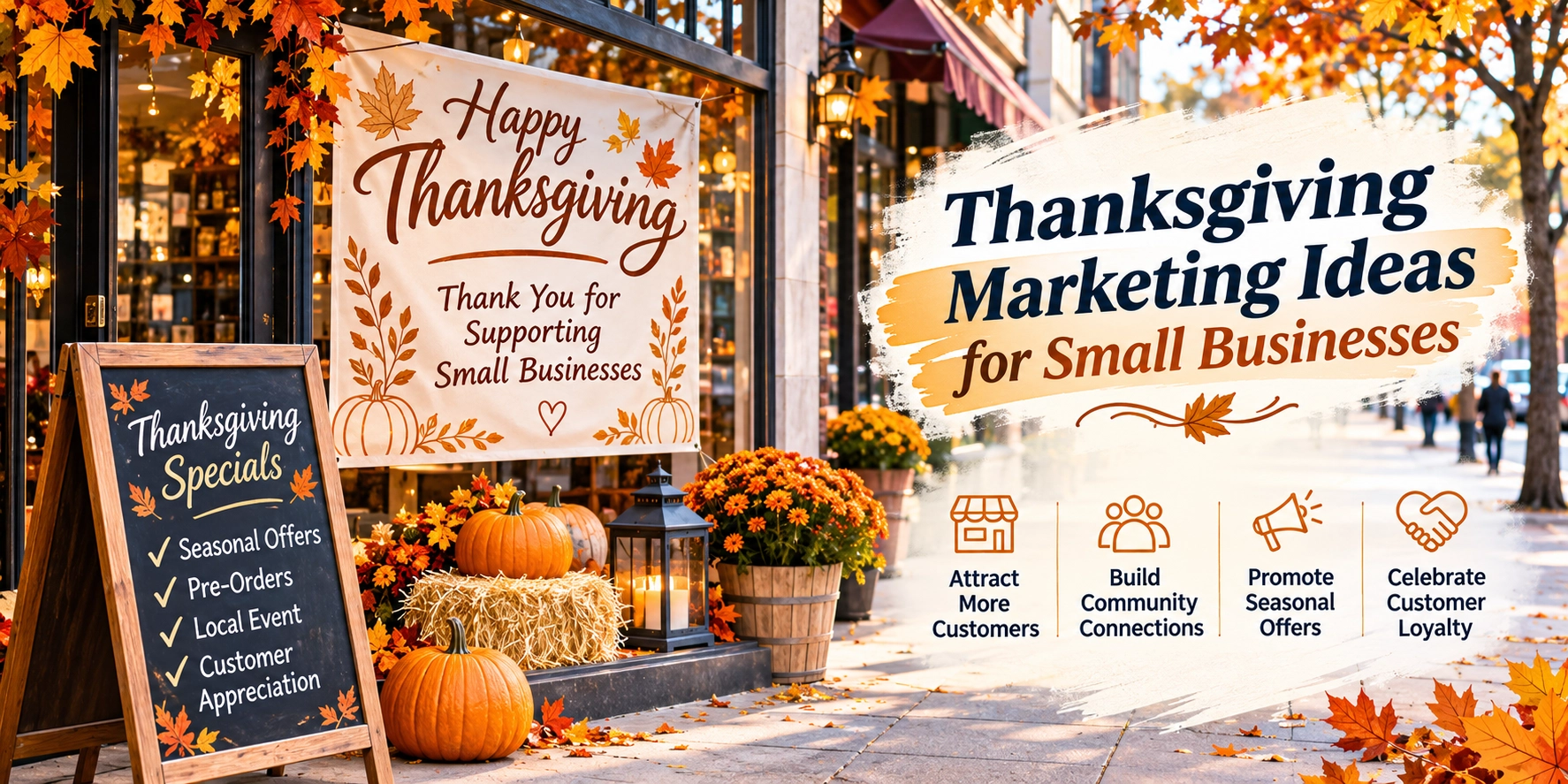
A Thanksgiving-themed storefront display can introduce your seasonal campaign, highlight an upcoming event, or announce a special offer. The key is to make the message visible without overwhelming the space.
Consider using:
- Window graphics to introduce your Thanksgiving theme.
- Outdoor banners to announce a seasonal event or promotion.
- Posters to highlight limited-time offers.
- Sidewalk signs to communicate a short, attention-grabbing message.
- Directional signs to guide visitors toward a specific entrance or display.
For example, a neighborhood boutique could use a simple window message such as:
"A Little Something to Be Thankful For. Join Us This Weekend!"
A bakery might use:
"Thanksgiving Pre-Orders Are Open. Reserve Your Favorites Today!"
These messages tell customers what is happening and what they should do next.
One important design rule: don't make people work to understand your sign. Use a short headline, readable typography, strong contrast, and enough open space. A sign that looks beautiful up close but cannot be understood from the sidewalk is not doing its job.
3. Build a Connected Experience From the Street to the Checkout Counter
One of the most overlooked Thanksgiving marketing opportunities is connecting every physical touchpoint.
A customer should not see one campaign outside your store, a completely different promotion inside, and an unrelated message at checkout.
Imagine a small retail store running a Thanksgiving customer appreciation weekend.
The experience could work like this:
Outside the store: A banner announces the customer appreciation event.
At the entrance: A poster introduces the special offer and event details.
Inside the store: Small signs identify featured products and seasonal collections.
At checkout: A counter card reminds customers about an upcoming holiday promotion or invites them to join the mailing list.
After the purchase: A thank-you card goes into the shopping bag.
Each piece has a different purpose, but they all support the same campaign.
This approach is especially useful for businesses that rely on walk-in traffic. Instead of expecting one sign to do all the work, give each display a specific job along the customer's path.
4. Create a Thanksgiving Offer That Gives Customers a Real Reason to Visit
Discounts are easy to announce, but they are not always the best way to attract attention.
Instead of automatically offering 20% off everything, think about what would make your customers genuinely interested.
A few possibilities include:
- A complimentary gift with a qualifying purchase.
- A seasonal product bundle.
- A limited-time service package.
- Early access to holiday products.
- A special offer for returning customer
- A free add-on with a booking or reservation.
For example, a home décor store could create a Thanksgiving table-setting bundle. A salon could offer a seasonal appointment package. A coffee shop could introduce a limited-edition drink and pastry combination.
The offer should make sense for your margins and your audience. A promotion that attracts customers but leaves the business with little profit is not necessarily a successful campaign.
Once you have selected your offer, make its details easy to find. Include the start and end dates, any restrictions, and a clear next step on your promotional materials.
5. Turn Your Window Display Into a Reason to Stop
A window display is not just decoration. It is a chance to communicate what makes your business worth visiting.
Rather than filling the entire window with generic Thanksgiving imagery, create a display around one idea.
A home goods store could showcase a Thanksgiving dinner table with featured products. A bakery could arrange seasonal desserts around a pre-order message. A clothing boutique could present a collection for family gatherings and holiday outings.
Use window decals, printed graphics, posters, or product displays to support the theme.
Keep the main message visible from outside, and avoid placing important information behind products or decorative elements. If customers need to walk closer to read the details, make sure the headline still gives them a reason to do so.
A thoughtful window display can work throughout the day, even when your team is busy serving customers inside.
6. Give Customers Something to Participate In
Marketing becomes more memorable when customers can take part instead of simply viewing another advertisement.
Thanksgiving offers several natural opportunities for participation.
You could create a gratitude wall where customers write down something they appreciate. A café might invite visitors to leave a message on a community board. A retail store could host a small customer appreciation activity. A fitness studio might organize a food drive or a group challenge.
If you are hosting an activity, make it easy to understand and participate in.
Use a small display near the entrance to explain what is happening. Add a sign with simple instructions, and make sure the activity does not interfere with normal customer movement.
You can also encourage customers to share their participation online, provided they are comfortable doing so.
The objective is not to manufacture social media engagement. It is to create a genuine experience that people may naturally want to talk about.
7. Use Thanksgiving Marketing to Support a Local Cause
Thanksgiving is an appropriate time to support people in your community, particularly families who may need additional help during the holiday season.
Your business could partner with a local food bank, community organization, school, or nonprofit to organize a food collection or donation drive.
For example:
- A grocery store could collect nonperishable food items.
- A restaurant could organize a meal donation initiative.
- A retail shop could collect winter clothing.
- A local gym could host a community donation event.
Promote the initiative clearly, explain where donations will go, and communicate how customers can participate.
Printed posters, entrance signs, counter displays, and social media announcements can help spread the message.
Keep the cause at the center of the campaign. Community involvement should be meaningful, not simply a seasonal marketing tactic.
8. Make Your Email Campaign Feel Personal
Email remains a useful way to communicate with existing customers, especially when your message is relevant and timely.
But your Thanksgiving email does not need to be another long promotional newsletter.
Start with a genuine thank-you. Mention something specific about the year, your customers, or the community you serve. Then introduce your seasonal announcement if you have one.
For example, a local business could send:
Subject: A Thanksgiving Thank-You From Our Team
"With Thanksgiving around the corner, we wanted to take a moment to thank you for being part of our journey this year. Your support means a great deal to our team, and we're grateful to have you as part of our community."
After the appreciation message, include a relevant offer, event announcement, or reminder about holiday hours.
A few practical email ideas:
- Send an early announcement about Thanksgiving events or pre-orders.
- Share a short customer appreciation message during Thanksgiving week.
- Remind customers about deadlines for seasonal products or services.
- Introduce your Small Business Saturday plans.
- Give loyal customers early access to a holiday offer.
Keep the email focused. One clear message and one primary call to action are usually more effective than several competing announcements.
9. Bring Your Online and Offline Branding Together
Customers move between digital and physical spaces without thinking about it. They might see your social media post, visit your website, and then walk into your store.
Your branding should feel familiar at every step.
Use the same campaign headline, colors, logo placement, and visual style across your website, email graphics, social media posts, and printed displays.
This does not mean every design needs to look identical. A storefront banner has different requirements from an Instagram post. But both should clearly belong to the same campaign.
You can also use QR codes on printed materials to connect customers to a specific online destination.
For example, a poster could link to:
- A Thanksgiving pre-order page.
- An event registration form.
- A seasonal product collection.
- A booking page.
- A page with complete promotion details.
Make sure the QR code is large enough to scan comfortably and has sufficient contrast. Always test it before sending the design to print.
10. Prepare Printed Materials for the Jobs They Need to Do
Not all promotional materials serve the same purpose. Choosing the right format depends on where the customer will see it and what you want them to do.
A few examples:
Vinyl banners: Useful for announcing larger events, customer appreciation weekends, or seasonal promotions where visibility from a distance matters.
Posters: Suitable for sharing more information about an event, offer, or seasonal collection inside a store or at a community location.
Window graphics: Helpful for communicating seasonal messages directly on storefront glass and making your business more noticeable.
Tabletop displays: Useful for promoting offers, menus, or event information at checkout counters, reception desks, and dining tables.
Retractable banner stands: A practical option for indoor events, pop-up displays, community gatherings, and promotional areas where you need a portable display.
Table covers: Useful for keeping your brand visible at Thanksgiving markets, local fairs, fundraising events, and community booths.
The goal is not to order every type of printed material. Select the formats that support your actual campaign and the spaces where customers will encounter them.
11. Give Your Team the Same Message to Work With
A marketing campaign can look excellent on paper and still fall short if the people interacting with customers do not know what is being promoted.
Before launching your Thanksgiving campaign, brief your team on the offer, important dates, event details, and customer questions they may receive.
Make sure everyone knows:
- What the promotion includes.
- When it starts and ends.
- Which products or services are included.
- Whether any restrictions apply.
- Where customers can find additional information.
You can also place a small reference card near the register or reception desk.
This is especially useful when several employees handle customer interactions. A consistent explanation builds confidence and prevents confusion.
12. Plan for Thanksgiving Pre-Orders and Reservations
Some businesses experience their biggest Thanksgiving opportunity before the holiday itself.
Restaurants, bakeries, caterers, florists, and specialty food stores can use advance orders and reservations to plan inventory, staffing, and production.
If your business offers seasonal products or services, make the ordering process clear.
Promote:
- What customers can order.
- Available sizes, packages, or options.
- The last date to place an order.
- Pickup or delivery arrangements.
- Payment and cancellation policies, where relevant.
- Put the deadline in prominent positions on your website, printed materials, and social media posts.
A message such as "Thanksgiving Orders Close November 20" is more useful than a general announcement saying that orders are available.
Clear information helps customers make decisions and gives your team a more manageable workload.
13. Use Customer Appreciation to Build Relationships Beyond November
Thanksgiving is a natural moment to recognize the people who have supported your business.
A personal thank-you can be more memorable than another discount code.
Depending on your business, you could:
- Include a thank-you card with purchases.
- Send a personal email to long-standing customers.
- Recognize loyal customers in a social media post, with their permission.
- Offer a small complimentary item.
- Invite regular customers to an appreciation event.
For businesses serving other businesses, a thoughtful message to clients and partners can also strengthen relationships.
Keep the message sincere. Customers can usually tell when appreciation is simply a wrapper around a sales pitch.
14. Make Small Business Saturday Part of the Plan
Thanksgiving is followed by one of the most important shopping opportunities for independent retailers: Small Business Saturday.
In 2026, Thanksgiving falls on Thursday, November 26, and Small Business Saturday is November 28.
Rather than treating the two occasions as separate campaigns, use Thanksgiving to introduce the idea and Small Business Saturday to give customers a reason to support local businesses.
A retail store might announce a Saturday-only offer during Thanksgiving week. A café could promote a special menu for shoppers. A local service business could offer gift cards or seasonal packages.
Prepare your signage, website information, and social media announcements in advance.
If you are participating in Small Business Saturday, make that clear. Customers should not have to guess whether your business is open, what is happening, or how they can take part.
15. Don't Forget Customers Who Shop Online
Even businesses with physical locations should make sure their online presence is ready for the holiday period.
Customers may check your website or business listing before visiting. Outdated opening hours, missing promotion details, or an unavailable booking link can create unnecessary frustration.
Before Thanksgiving, review:
- Your website's opening hours and holiday announcements.
- Your Google Business Profile hours.
- Your current contact information.
- Product availability and order deadlines.
- Online booking or checkout links.
- Mobile display and page loading experience.
If you are running a Thanksgiving campaign in-store, make sure the relevant details are also available online.
The experience should be straightforward whether someone discovers your business through a sign, a search result, or a social media post.
16. Design for Visibility, Not Just Decoration
Seasonal marketing often encourages businesses to use more colors, more graphics, and more decorative elements.
But more design does not automatically mean more attention.
A strong Thanksgiving display should make three things clear:
- What is the message?
- Why should the customer care?
- What should the customer do next?
Use Thanksgiving colors and imagery to establish the mood, but keep your brand recognizable. Your logo should remain visible, your headline should be easy to read, and your offer should not disappear beneath decorative elements.
Also consider the viewing distance. A banner displayed outside a store needs a different layout from a small tabletop sign. Text that looks readable on a computer screen may become difficult to read when printed at a larger size or viewed from across a parking lot.
Always review the final artwork at its intended size and placement before approving production.
17. Create a Simple Thanksgiving Marketing Timeline
A good campaign needs enough time for planning, design, production, and promotion. Leaving everything until Thanksgiving week can create avoidable pressure.
For the 2026 holiday season, here's a practical schedule.
November 3-8: Finalize the campaign
Choose your main message, offer, event plans, and target audience. Confirm your holiday hours and identify the marketing materials you actually need.
November 9-15: Prepare and launch
Finalize your designs, arrange printing, update your website, and begin promoting seasonal products, events, or pre-orders.
November 16-22: Build awareness
Increase the frequency of relevant social media and email communication. Install your storefront displays and remind customers about important order deadlines.
November 23-25: Share final reminders
Confirm Thanksgiving hours, event details, collection arrangements, and any last ordering deadlines. Make sure your team has the information it needs.
November 26: Thanksgiving Day
Share a genuine message of appreciation. If your business is closed, make sure customers already know.
November 27-30: Continue the holiday campaign
Move into your Black Friday, Small Business Saturday, and Cyber Monday plans where relevant. Keep the messaging connected, but give each promotion its own clear purpose.
This schedule is a planning framework, not a requirement to publish something every day. A few well-executed activities can be more effective than trying to do everything at once.
18. Measure What Actually Worked
Once Thanksgiving is over, take a little time to review the campaign.
Do not judge its success only by likes, impressions, or how many promotional materials you ordered.
Look at the results that matter to your business.
Depending on your campaign, track:
- Store visits during the promotion.
- Sales from seasonal offers.
- Number of pre-orders or reservations.
- QR code scans and website visits.
- Email clicks and responses.
- Event attendance.
- New customer enquiries.
- Repeat purchases after Thanksgiving.
If you used different promotional codes or QR codes across your materials, compare their performance. You may discover that a simple window display generated more visits than a larger social media campaign.
Use those findings to make your Christmas and New Year marketing more effective.
Frequently Asked Questions About Thanksgiving Marketing
When should small businesses start Thanksgiving marketing?
Ideally, begin planning three to four weeks before Thanksgiving. This gives you time to develop your campaign, prepare printed materials, update your website, and communicate with customers. Businesses that rely on pre-orders or event bookings may need to start earlier.
What are some affordable Thanksgiving marketing ideas?
Some practical options include a customer appreciation email, a simple storefront display, a social media gratitude campaign, a small seasonal offer, a community donation drive, or a customer appreciation event. Choose activities that fit your audience and budget rather than trying to run several campaigns simultaneously.
What should a small business include in a Thanksgiving promotion?
Keep the promotion easy to understand. Include the offer, applicable products or services, start and end dates, important restrictions, and a clear call to action. If customers need to book, order, or visit a particular location, explain exactly how.
How can printed signage help with Thanksgiving marketing?
Printed signage makes your campaign visible in physical spaces where customers make decisions. Banners can announce events, window graphics can attract attention from outside, posters can explain promotions, and counter displays can reinforce an offer at checkout. Each format should have a specific purpose.
How can businesses connect Thanksgiving marketing with Small Business Saturday?
Use Thanksgiving week to introduce your Small Business Saturday plans. Announce the offer early, prepare storefront signage, update your online information, and remind customers why shopping locally matters. In 2026, Small Business Saturday falls on November 28.
Final Thoughts
The strongest Thanksgiving marketing campaigns are not necessarily the biggest or most expensive. They are the ones that make customers feel welcome, communicate clearly, and create a consistent experience.
A well-placed storefront banner, a thoughtful window display, a personal thank-you message, and a helpful sign at checkout can work together to make a small business more memorable.
Start with one clear message. Choose the marketing materials that support it. Give customers a reason to engage, and make sure the experience feels just as thoughtful in person as it does online.
Thanksgiving is an opportunity to recognize the people who helped your business get where it is today. Make that appreciation visible, genuine, and part of the experience customers remember.