A banner can look great on a computer screen and still be the wrong banner for the job.
That happens more often than you might think.
A business may choose a lightweight vinyl banner for an outdoor installation because it looks good and costs less. A trade show exhibitor may choose a standard vinyl banner when a smoother, low-memory material would create a much more polished presentation. Or someone may install a large solid vinyl banner on a construction fence without considering how much wind the installation could encounter.
The artwork isn't always the problem. Sometimes, the material is.
When you're ordering custom banners, the right material depends on where the banner will be displayed, how it will be installed, how long you plan to use it, and what kind of appearance you want.
Indoor and outdoor banners don't have to follow a strict "one material for indoors, another for outdoors" rule. Several vinyl options can work in both environments. The smarter approach is to understand what each material does well and choose accordingly.
In this guide, we'll break down the most common indoor and outdoor banner materials, including 13 oz Vinyl, 15 oz Vinyl, 18 oz Vinyl, Wrinkle-Free Fabric, 14 mil Double White Popup, 18 oz Blockout Vinyl, and 10 oz Heavy-Duty Mesh Banner.
Indoor vs. Outdoor Banners: What's the Difference?
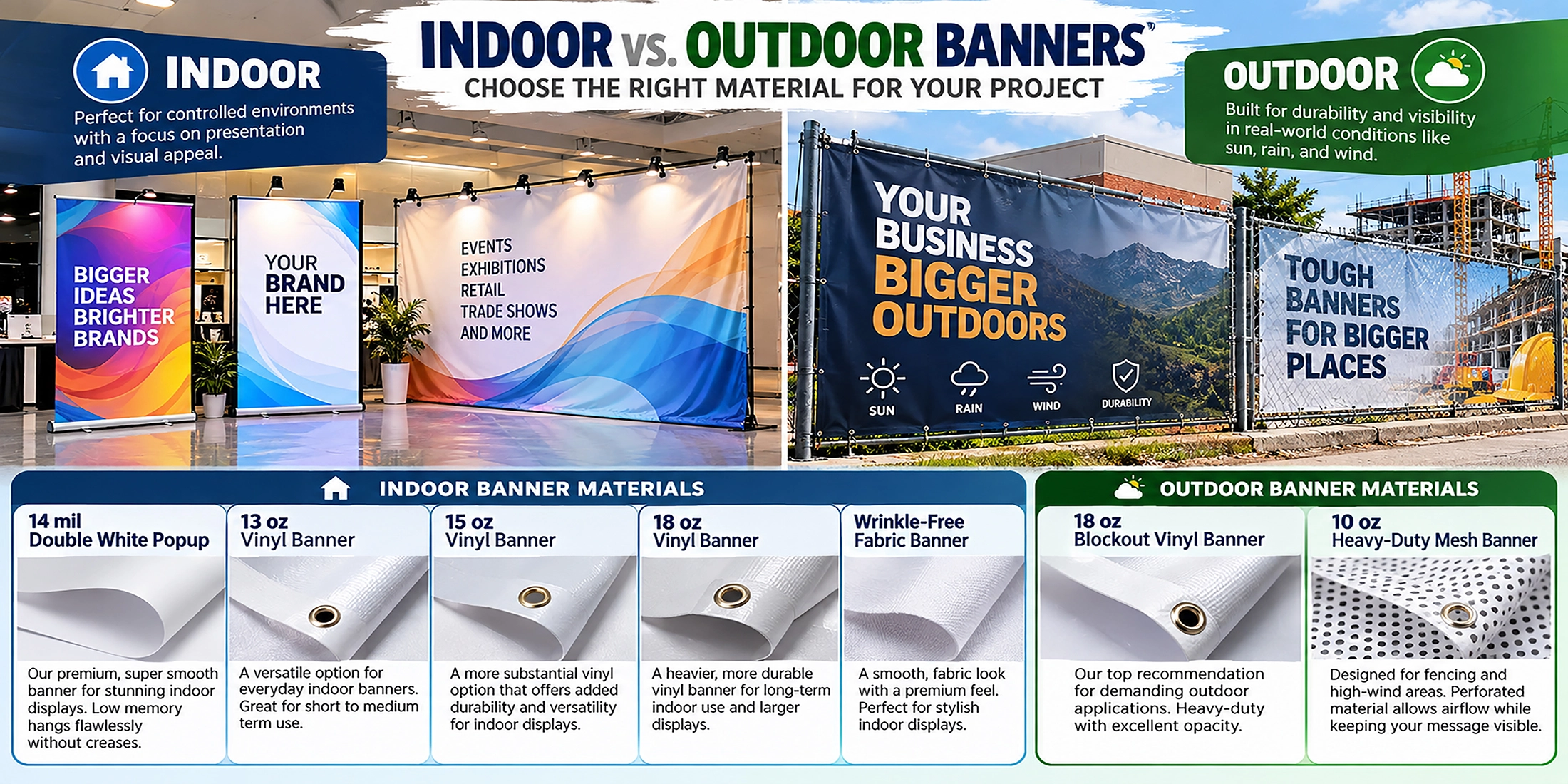
Indoor banners are generally selected with presentation, visual appeal, surface quality, and how the material hangs in mind. They are commonly used in controlled environments such as retail stores, trade shows, exhibitions, corporate events, schools, and indoor promotions.
Outdoor banners have a different set of considerations. They may need to deal with sunlight, moisture, wind, changing temperatures, and longer periods of exposure. Installation also becomes more important, particularly with large banners.
Popular indoor materials include vinyl, fabric, and premium specialty materials such as 14 mil Double White Popup. Outdoor applications commonly use vinyl, blockout vinyl, and mesh.
The important part is this: there isn't one universal "best banner material." The right material depends on the application.
For premium indoor presentation, 14 mil Double White Popup is a standout choice because of its super-smooth surface and low-memory characteristics. For demanding outdoor solid-banner applications, 18 oz Blockout Vinyl is our primary recommendation. And when you're covering a fence where wind is a major consideration, 10 oz Heavy-Duty Mesh has a very different advantage.
Best Indoor Banner Materials
Indoor environments give you more freedom when choosing a banner material. You don't usually have to account for rain, snow, or strong outdoor wind, which means you can put more emphasis on appearance, handling, and the overall presentation.
Here are the main options to consider.
14 mil Double White Popup: When Indoor Presentation Matters Most
If your banner is going to be displayed indoors and you want the finished graphic to look exceptionally clean, 14 mil Double White Popup deserves a serious look.
This is our premium indoor option for a reason.
The material has a super-smooth surface designed to showcase printed graphics beautifully. Colors can look vivid, details remain crisp, and the smooth finish gives the display a more refined appearance.
But the real advantage is its low memory.
Some banner materials can retain curls or creases from being rolled, transported, or stored. Double White Popup is designed to hang more naturally and smoothly, helping your graphic avoid that "freshly unrolled banner" look.
That makes a difference when your audience is standing close to the display.
Think about a trade show booth, showroom, corporate event, retail environment, or indoor promotional display. People aren't necessarily viewing the banner from 50 feet away. They're walking right past it.
At that distance, the little things matter.
Why choose 14 mil Double White Popup?
- Super-smooth printing surface
- Designed for vivid, high-impact graphics
- Low-memory material
- Helps the banner hang smoothly
- Premium indoor appearance
- Excellent choice when presentation is a priority
Ideal applications: Trade shows, exhibitions, retail displays, corporate events, indoor advertising, branded environments, and professional presentations.
If your question is, "What is the best indoor banner material for a polished presentation?", this is where we'd start.
13 oz Vinyl Banner: Versatile and Practical
Not every project needs a premium specialty material.
Sometimes you need a straightforward banner that gets the job done without overcomplicating the purchase.
That's where 13 oz Vinyl Banner makes sense.
It is a practical, versatile option for everyday signage and promotional graphics. It can be used indoors and, depending on the application and exposure, outdoors as well.
For temporary promotions, retail advertising, school events, seasonal messaging, sales announcements, and general-purpose signage, 13 oz vinyl can be a very sensible choice.
It's also worth considering when you're ordering multiple banners and keeping the overall project budget under control.
The key is to match the material to the job rather than automatically paying for more material than you actually need.
15 oz Vinyl Banner: A More Substantial Vinyl Option
Want something a little heavier than 13 oz vinyl?
15 oz Vinyl Banner gives you another versatile option.
It sits comfortably between lighter standard vinyl and heavier-duty options, making it useful for customers looking for a more substantial banner without necessarily moving all the way up to an 18 oz material.
Like 13 oz vinyl, it can be used for a variety of indoor applications and suitable outdoor applications.
Ideal applications: Commercial promotions, retail signage, events, business advertising, indoor displays, and general-purpose banner projects.
The right choice between 13 oz and 15 oz often comes down to the specific application, desired material weight, and budget.
18 oz Vinyl Banner: When You Want More Material
Sometimes you simply want a banner with more substance.
That's where 18 oz Vinyl Banner comes in.
Its heavier construction makes it a practical choice for applications where a more substantial vinyl material is preferred, including larger displays, commercial signage, recurring promotions, and projects that will be handled repeatedly.
It can also be used outdoors when the application is appropriate.
One important distinction, however, is that 18 oz Vinyl and 18 oz Blockout Vinyl aren't necessarily the same thing.
Blockout construction provides additional opacity, which can be valuable when you want to limit light transmission through the banner.
That distinction becomes especially relevant for outdoor advertising and certain indoor installations.
Wrinkle-Free Fabric Banner: A Different Look for Indoor Displays
Not every indoor banner needs to look like traditional vinyl.
Wrinkle-Free Fabric Banner gives you another direction entirely.
Fabric has a softer, more textile-like appearance than vinyl, which can work particularly well in environments where you want your graphics to feel integrated into the overall space rather than simply attached to it.
It's a natural fit for exhibitions, corporate events, photography areas, branded environments, and indoor displays where presentation matters.
The wrinkle-resistant characteristics are also useful when graphics need to be transported, handled, and displayed repeatedly.
If you're deciding between vinyl and fabric for an indoor display, the question isn't necessarily which one is "better."
It's which visual experience fits your project.
Best Outdoor Banner Materials
Outdoor banners have more to deal with.
A banner hanging outside may encounter direct sunlight, rain, wind, temperature changes, and physical movement. The larger the banner and the more exposed the installation, the more important material selection and installation become.
Several of our vinyl materials can be used outdoors, but two materials deserve particular attention for specific outdoor applications.
18 oz Blockout Vinyl Banner: Our Go-To Outdoor Recommendation
When customers ask us which material we'd recommend for a demanding solid outdoor banner, our starting point is 18 oz Blockout Vinyl.
It combines heavy-duty 18 oz construction with blockout properties that help prevent unwanted light transmission through the banner.
Why does that matter?
Imagine a banner installed where sunlight or another light source is behind it. With a standard material, light transmission can affect how the graphic appears.
Blockout vinyl is designed to provide a more opaque surface, helping the printed graphic maintain a strong, consistent appearance.
That makes it particularly useful for outdoor advertising, storefront promotions, commercial signage, events, and larger promotional installations.
Why choose 18 oz Blockout Vinyl?
- Heavy-duty 18 oz construction
- Excellent opacity
- Designed to limit light transmission
- Strong choice for demanding outdoor applications
- Suitable for large-format advertising
- Can also be used indoors when opacity is important
This doesn't mean every outdoor banner needs 18 oz Blockout Vinyl.
A short-term promotional banner in a sheltered location has different requirements from a large banner expected to remain outside for an extended period.
But if you're asking us where to start for a solid, heavy-duty outdoor banner, this is the material we'd point you toward first.
10 oz Heavy-Duty Mesh Banner: Built for Fence Advertising
Now let's talk about an outdoor application where the material choice can change completely.
Fencing.
If you're putting a banner on a construction fence, event fence, sports-field fence, or another large perimeter structure, wind needs to be part of the conversation.
A solid vinyl banner creates a continuous surface. When wind hits that surface, it can place significant force on the banner and its attachment points.
That's where 10 oz Heavy-Duty Mesh Banner comes into play.
Mesh banners contain small perforations that allow air to pass through the material. This makes mesh particularly useful for outdoor fencing applications where airflow is an important consideration.
Why choose Heavy-Duty Mesh?
- Perforated construction allows airflow
- Well suited to fence installations
- Useful for large outdoor perimeter graphics
- Excellent for construction-site advertising
- Suitable for event and sports fencing
- Helps address wind exposure differently than solid vinyl
There is a trade-off.
Because the material contains small openings, mesh does not have the same solid visual surface as vinyl. Graphics can appear slightly less dense, especially at close range.
But for fence advertising viewed from a reasonable distance, that trade-off can make a lot of sense.
If you're covering a fence, don't automatically assume you need solid vinyl. Think about wind first.
And remember: mesh reduces wind loading, but it does not make an installation immune to strong weather. Proper attachment and a suitable supporting structure still matter.
Can 13 oz, 15 oz, and 18 oz Vinyl Be Used Outdoors?
Yes.
This is an important point because people sometimes assume that anything other than a heavy-duty outdoor material automatically belongs indoors.
That's not how banner materials work.
13 oz Vinyl, 15 oz Vinyl, and 18 oz Vinyl can all be used for suitable outdoor applications.
The right choice depends on the project.
For example, a temporary outdoor promotion may have very different requirements from a large banner installed in a highly exposed location. A storefront banner under some shelter has different conditions from a roadside banner facing direct weather.
Instead of asking only, "Can this material be used outdoors?" ask:
- How long will it be outside?
- How exposed will it be?
- How large is the banner?
- How will it be installed?
- Does wind matter?
- Do I need additional opacity?
Those questions will lead you toward a much better material choice.
Indoor vs. Outdoor Banners: A Quick Comparison
Indoor banners are generally chosen with presentation and visual appeal in mind, making them ideal for controlled environments such as retail stores, trade shows, exhibitions, and events. Popular indoor materials include 14 mil Double White Popup, vinyl, and wrinkle-free fabric, with 14 mil Double White Popup standing out when a smooth, premium presentation is the priority. Outdoor banners, on the other hand, need to account for durability, weather exposure, visibility, and wind, especially for larger installations. Common outdoor options include 18 oz Blockout Vinyl, standard vinyl, and heavy-duty mesh, with 18 oz Blockout Vinyl being our primary recommendation for demanding solid-banner applications and 10 oz Heavy-Duty Mesh being particularly useful for fencing where airflow matters. The right choice ultimately depends on where your banner will be displayed, how long it will be used, and the conditions it will need to handle.
How to Choose the Right Banner Material
Still not sure which banner material makes sense?
Start with the environment and work backward.
If it's a premium indoor display
Look at 14 mil Double White Popup.
It's particularly well suited to projects where a smooth surface, vibrant graphics, and a clean hanging appearance are priorities.
If you need an everyday indoor banner
Consider 13 oz Vinyl, 15 oz Vinyl, or 18 oz Vinyl, depending on the material weight and overall requirements of the project.
If you want a fabric appearance
Choose Wrinkle-Free Fabric Banner for a softer, more textile-like indoor presentation.
If it's a demanding outdoor solid banner
Start with 18 oz Blockout Vinyl.
Its heavy-duty construction and opacity make it our primary outdoor recommendation for solid-banner applications.
If you're covering a fence
Look at 10 oz Heavy-Duty Mesh Banner.
The perforated material allows airflow and makes it particularly suited to fencing and other applications where wind needs to be considered.
5 Common Banner-Material Mistakes to Avoid
1. Choosing Only Based on Price
The cheapest material isn't automatically the most economical choice.
If a banner needs to perform in a demanding environment, selecting material based purely on price can create problems later.
Think about the complete use case instead.
2. Ignoring Wind
This is especially important for large outdoor banners.
If you're installing a graphic on fencing or another exposed structure, consider whether mesh would make more sense than a solid banner.
3. Forgetting How the Banner Will Hang
A banner isn't just a printed rectangle.
How it will be mounted matters.
Grommets, hemming, pole pockets, and other finishing options can affect how the finished banner is installed and displayed.
Tell your printer how you plan to install the banner before production so the finishing can be configured appropriately.
4. Choosing the Material Before Thinking About the Environment
Don't start with "Which material is best?"
Start with:
Where is it going?
Then consider the duration, exposure, viewing distance, installation method, and desired appearance.
The answer becomes much easier.
5. Assuming Heavier Always Means Better
More material isn't automatically better for every project.
A lightweight temporary promotion doesn't necessarily need the same construction as a long-term outdoor installation.
Likewise, a fence banner may benefit more from a mesh construction than simply moving to a heavier solid vinyl.
The goal isn't to buy the heaviest banner.
The goal is to buy the right banner.
Frequently Asked Questions About Indoor and Outdoor Banners
What is the best material for indoor banners?
For a premium indoor presentation, 14 mil Double White Popup is an excellent option. Its super-smooth surface and low-memory characteristics make it particularly suitable when a polished, smooth-hanging appearance is important. Vinyl and wrinkle-free fabric are also useful for different indoor applications.
What is the best material for outdoor banners?
For demanding solid outdoor applications, we recommend starting with 18 oz Blockout Vinyl. It provides heavy-duty construction and excellent opacity. For fencing and other applications where airflow is important, 10 oz Heavy-Duty Mesh is a specialized alternative.
Can 13 oz Vinyl be used outdoors?
Yes. 13 oz Vinyl can be used outdoors for suitable applications. The expected duration, weather exposure, banner size, installation method, and location should all be considered when choosing the material.
Can 15 oz Vinyl be used outdoors?
Yes. 15 oz Vinyl can also be used outdoors for appropriate applications. It offers a more substantial vinyl option while remaining versatile.
Can 18 oz Vinyl be used outdoors?
Yes. 18 oz Vinyl can be used outdoors. If you specifically need increased opacity and a heavy-duty solid outdoor banner, however, 18 oz Blockout Vinyl is the material we'd recommend considering first.
What is a blockout vinyl banner?
Blockout vinyl is designed to limit light transmission through the banner. This provides a more opaque surface and can help maintain a consistent appearance when light is present behind the graphic.
What is a mesh banner used for?
Mesh banners are commonly used for outdoor applications where airflow matters. They are particularly popular for construction fencing, event fencing, sports fencing, and large perimeter installations.
Is fabric better than vinyl for indoor banners?
Not universally. Fabric and vinyl offer different visual characteristics. Fabric provides a softer, textile-like appearance, while vinyl offers a more traditional banner surface and broad versatility. The right choice depends on the look and performance you want.
What makes 14 mil Double White Popup different?
Its biggest advantages are its super-smooth surface and low-memory characteristics. The material is designed for premium indoor graphic presentation and can hang smoothly with fewer unwanted creases.
Do I need a different banner for indoor and outdoor use?
Not necessarily. Several materials, including 13 oz, 15 oz, and 18 oz vinyl, can work in both environments. What changes is the performance requirement. Outdoor installations require more consideration of weather, wind, exposure, and installation conditions.
Final Thoughts: The Right Banner Starts With the Right Material
Choosing a custom banner shouldn't be complicated.
But it also shouldn't be reduced to choosing the thickest material or simply picking the lowest price.
The right banner material depends on what you're actually trying to accomplish.
For premium indoor presentation, 14 mil Double White Popup gives you a smooth, polished surface designed to let your graphics take center stage.
For everyday indoor and suitable outdoor applications, 13 oz, 15 oz, and 18 oz Vinyl provide versatile options across different project requirements.
For a softer indoor appearance, Wrinkle-Free Fabric offers a completely different visual experience.
And when you're taking your graphics outside, 18 oz Blockout Vinyl is our primary recommendation for demanding solid-banner applications, while 10 oz Heavy-Duty Mesh is a particularly smart option for fencing where airflow matters.
There is no single banner material that wins every job.
There is only the material that makes the most sense for your job.
And that's the real secret to ordering a banner you'll be happy with: choose the environment first, then choose the material.
Ready to Choose Your Banner?
Whether you're preparing for a trade show, promoting a retail sale, branding an event, advertising on a storefront, or covering a construction fence, choosing the right material is the first step toward a better finished display.
Explore the available banner materials and choose the one that fits your application, artwork, installation, and environment.
Great graphics deserve the right material to bring them to life.